
Senior Care · Reviews
5 Best Heating Pads for Arthritis

Heat is one of the simplest ways to relieve arthritis pain: it loosens stiff joints and boosts blood flow to reduce pain, and it helps both osteoarthritis and rheumatoid arthritis. The question is which arthritis heating pad fits the joint you need to treat.
For most back, shoulder, and knee arthritis pain, the Sunbeam XL is the most practical everyday pick — at 12 × 24 inches it covers the whole sore area in one placement, it has six heat settings, and it shuts off automatically if you fall asleep on it. For deeper joint heat, the Thermophore MaxHEAT automatically generates moist heat from the moisture in the air, the way physical therapy clinics do, without any wet towel or sponge. For people who travel, sleep away from an outlet, or want heat after a walk without sitting next to a socket, a microwavable pack is the answer. And when the arthritis is concentrated in the knee or shoulder rather than a flat surface, a fitted wrap that stays in place beats a flat pad that slides off.
We may earn a commission when you buy through links on this page. Read our affiliate disclosure.
- Check it outSunbeam XL Heating Pad (12 × 24 in)Best overall12 × 24 in (XL)6 heat levelsAutomatic shut-offRead full review
- Check it outThermophore MaxHEAT Moist Heat PackBest moist heatAutomatic moist heatAbsorbs moisture from airSwitch-activated (releases to cool)Read full review
- Check it outPure Enrichment PureRelief XL Heating PadBest large areaXL (wider coverage)6 heat levelsUltra-plush microfiber

Our Top Pick
Sunbeam XL Heating Pad (12 × 24 in)
Two things make a heating pad genuinely useful for arthritis, and this one has both.
- Extra-large 12 × 24 in — covers a full back, both knees, or a whole shoulder
- Six heat settings, so you can find the level that actually helps
- Automatic shut-off — the safety feature that matters if you fall asleep on it
- 180 W: it heats properly rather than staying lukewarm
Size
12 × 24 in (XL)
Settings
6 heat levels
Safety
Automatic shut-off
Sunbeam XL Heating Pad (12 × 24 in)
The Sunbeam XL wins on the two things that decide whether a heating pad actually gets used. The first is size. At 12 × 24 inches it covers a whole lower back, both knees together, or an entire shoulder in one placement — where a standard pad has to be repositioned every few minutes, using the same stiff, sore hands you are trying to treat.
The second is the automatic shut-off. Heat is relaxing, people fall asleep on it, and older skin is thinner and slower to register that it is being burned. A pad without a shut-off is not one we would put in front of a senior. Add six heat settings for real control over intensity, and 180 watts so it genuinely warms rather than merely takes the chill off, and it covers the great majority of arthritis heat therapy without fuss.
What we love
- Extra-large 12 × 24 in — covers a full back, both knees, or a whole shoulder
- Six heat settings, so you can find the level that actually helps
- Automatic shut-off — the safety feature that matters if you fall asleep on it
- 180 W: it heats properly rather than staying lukewarm
Things to consider
- Corded — it needs an outlet, so it is no use away from a socket
- For deep moist heat, the moist-heat pick below is the specialist
- The listing does not state the shut-off timer or whether the cover is washable — worth checking
Right for you if
- ✓Daily heat therapy at home for back, knee, or shoulder arthritis
- ✓You want one placement to cover the whole sore area
- ✓You sometimes doze off during a session and need the shut-off
Maybe skip it if
- !Deep moist heat, especially for hands and wrists (get the Thermophore)
- !Travel, or anywhere without an outlet (get the Carex microwavable)
- !A joint a flat pad slides off (get the Renue wrap)
What owners consistently report
Common praise
- +The 12 × 24 size is the main reason to choose it — one placement covers the area
- +Six settings give genuine control; three is often not enough
- +The automatic shut-off is what makes it safe to use in a recliner
Common gripes
- –It needs an outlet — decide where you will sit before you start
- –Start on a low setting and work up; do not begin at maximum
- –Do not exceed the recommended session length, even with the shut-off
Getting started
- →Place the pad on the target area before switching it on, not the other way round
- →Start at a lower setting and increase gradually — do not start at maximum
- →Check the skin after the first few uses for redness beyond normal warmth
How it compares to our runner-up
If moist heat for hands or smaller joints is the priority, the Thermophore MaxHEAT is the better choice — automatic moist heat at the level physical therapists use. Choose the Sunbeam XL for general-purpose, large-area heat; choose the Thermophore when the joint needs true moist heat.
How we picked
We compared 5 options. Our picks are based on manufacturer specifications, physical-therapy and rheumatology guidance, and verified owner reviews — not independent clinical testing. Heat therapy is widely recommended for arthritis as a complement to medical treatment, not a replacement. We focused on what matters for safe daily use by seniors: temperature settings and auto-shutoff (burns are a real risk, especially for people with reduced sensation), size and coverage, moist versus dry heat, and whether the device stays in place on the target joint. Always follow the 20-minutes-on, 20-minutes-off guideline and use a protective layer if skin sensation is reduced. Consult a doctor or physical therapist before starting regular heat therapy, particularly if circulation or sensation is affected.
Reviewed by SK Kutubuddin — who researches senior-care products and the real-world needs of caregivers and older adults.
Our picks, reviewed
Sunbeam XL Heating Pad (12 × 24 in)
Read our full Sunbeam XL Heating Pad (12 × 24 in) reviewTwo things make a heating pad genuinely useful for arthritis, and this one has both. Size: at 12 × 24 inches it covers a whole lower back, both knees at once, or an entire shoulder — a small pad has to be shuffled around the sore area, which is exactly what you do not want to be doing with stiff, painful hands. And control: six heat settings let you find the level that actually helps, rather than choosing between scalding and pointless.
The feature that matters most, though, is the automatic shut-off. Heat therapy is relaxing, people doze off, and a pad that stays on is a real burn risk on older skin, which is thinner and slower to register heat than it used to be. Every pad we recommend has to have one. This one does.
What we like
- Extra-large 12 × 24 in — covers a full back, both knees, or a whole shoulder
- Six heat settings, so you can find the level that actually helps
- Automatic shut-off — the safety feature that matters if you fall asleep on it
- 180 W: it heats properly rather than staying lukewarm
Keep in mind
- Corded — it needs an outlet, so it is no use away from a socket
- For deep moist heat, the moist-heat pick below is the specialist
- The listing does not state the shut-off timer or whether the cover is washable — worth checking
- Size
- 12 × 24 in (XL)
- Settings
- 6 heat levels
- Safety
- Automatic shut-off
Thermophore MaxHEAT Moist Heat Pack
Read our full Thermophore MaxHEAT Moist Heat Pack review
Moist heat penetrates joints more effectively than dry heat because water conducts heat better than air, delivering more therapeutic warmth at the same surface temperature. The Thermophore MaxHEAT generates this moist heat automatically by using the natural moisture in the air — you do not need a wet towel, a sponge, or a spray bottle. This is how clinics and physical therapists deliver heat therapy, and it is why the Thermophore is the standard recommendation for hands, wrists, and smaller arthritic joints. The switch design allows a single hand (or even the weight of the body) to keep it activated. Higher upfront cost than a standard pad, but a genuinely different level of therapeutic heat.
What we like
- Automatic moist heat — no wet sponge or spray required
- Deeper therapeutic penetration than dry heat for arthritic joints
- The clinical standard for moist heat therapy
- Switch-held design prevents leaving it on too long
Keep in mind
- More expensive than a standard electric pad
- The switch-held design (hold switch to heat) can be tiring for arthritic hands over a long session
- Smaller coverage area than the Sunbeam XL
- Heat type
- Automatic moist heat
- Mechanism
- Absorbs moisture from air
- Safety
- Switch-activated (releases to cool)
Pure Enrichment PureRelief XL Heating Pad

For arthritis affecting multiple joints or the full back, Pure Enrichment’s XL pad offers an extra-large coverage area with a soft, ultra-plush microfiber surface that feels gentler against sensitive skin. Six heat settings, a fast heat-up, and a 2-hour auto-shutoff round out a capable pad. It consistently earns strong reviews from arthritis patients who need to cover more than a single joint at once, and the extra-plush surface is a genuine comfort difference from firmer standard pads.
What we like
- Extra-large size for full-back or multi-joint coverage
- Ultra-plush microfiber is gentler on sensitive arthritic skin
- 6 settings and an automatic shut-off
- Strong owner reviews specifically from arthritis patients
Keep in mind
- Bulkier to store than a standard-size pad
- Still requires an outlet; dry heat only unless you spray the pad
- Size
- XL (wider coverage)
- Settings
- 6 heat levels
- Surface
- Ultra-plush microfiber
Carex Bed Buddy Microwavable Heat Pack
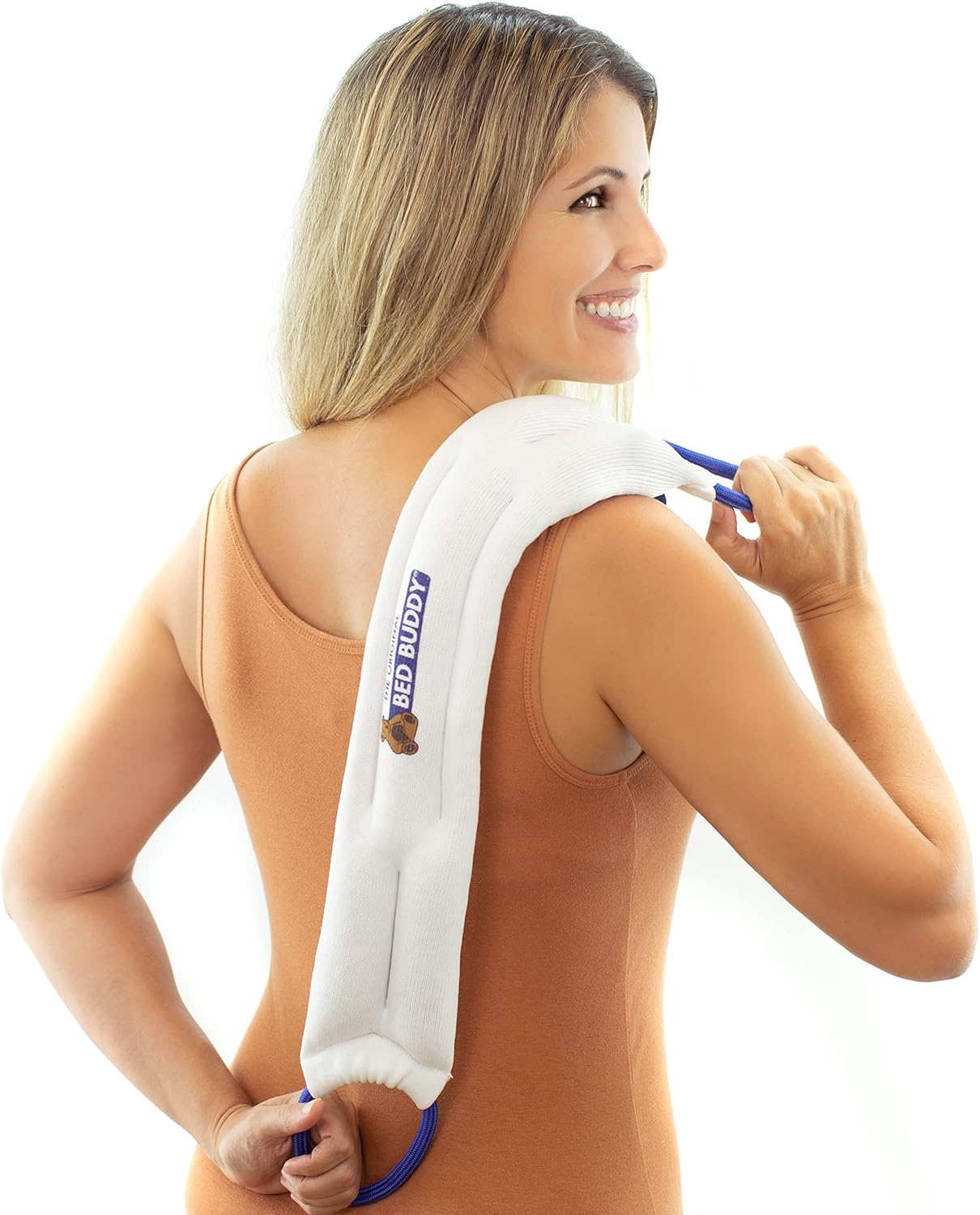
When an outlet is not the answer — travel, in bed at night, after a morning walk before sitting down at a table — a microwavable pack is the most practical option. The Carex Bed Buddy uses grain filling that holds and radiates heat steadily, and it naturally conforms to the body area it is placed on. No cord, no controller, no auto-shutoff to think about (the heat simply dissipates). It is also genuinely portable: take it in a bag. The trade-off is that the heat lasts around 20–30 minutes before it cools, and microwavable packs should not be reheated if still warm to avoid hotspots.
What we like
- No cord, no outlet needed — fully portable
- Conforms to the body area; natural heat that fades safely
- Useful in bed, while travelling, or at the kitchen table
- Simple: microwave and apply, no settings needed
Keep in mind
- Heat lasts 20–30 minutes, not sustained like electric
- Do not reheat while still warm — risk of hotspots
- Cannot precisely control temperature
- Type
- Microwavable (cordless)
- Heat duration
- 20–30 min per use
- Safety
- Natural heat dissipation
Sunbeam Renue Heat Therapy Wrap

A flat heating pad slides off the knee or shoulder in minutes. A wrap that secures around the joint stays in place during the entire session, which is the practical difference between heat therapy that works and heat therapy that gets abandoned. The Sunbeam Renue wraps around knees, shoulders, or the neck with straps, delivering targeted heat to the joint from all sides rather than just one flat surface. The trade-off is that it covers a smaller total area than a large flat pad, making it the right choice for joint-specific pain rather than broad back pain.
What we like
- Stays in place on the knee, shoulder, or neck — no sliding
- Heats the joint from multiple directions
- Auto-shutoff and adjustable heat settings
- Practical for joint-specific arthritis pain
Keep in mind
- Covers less total area than a full flat pad
- Less useful for broad back or multi-joint pain
- Form
- Wrap (stays on joint)
- Target
- Knee, shoulder, neck
- Heat type
- Dry or moist (spray)
What to look for
Moist heat versus dry heat for arthritis
This is the most important distinction for arthritis. Moist heat penetrates joints more effectively than dry heat because water conducts heat better than air — meaning you get more therapeutic warmth at the same surface temperature with less risk of burning the skin. Physical therapists consistently prefer moist heat for arthritis, particularly for hands, wrists, and smaller joints.
Dry heat (standard electric pad) still helps; it is just slightly less efficient. You can convert most electric pads to moist heat by lightly spraying the fabric with water before use. The Thermophore generates true moist heat automatically.
Auto-shutoff is not optional for seniors
Falling asleep on a heating pad is a burn risk, and burn risk is higher in older adults because skin is thinner, circulation may be reduced, and sensation is sometimes diminished. Every heating pad in this guide has an auto-shutoff; it is the single most important safety feature. Two hours is the typical window and is consistent with clinical guidance on safe heat therapy session lengths.
Never use a heating pad on a setting that feels too hot, directly on broken skin, or over an area that cannot sense heat properly. If sensation is reduced in the target area, use the lowest setting and check the skin after every 10 minutes.
Match the shape to the joint
- Flat pad: back, full back, both knees flat on a surface, large muscle groups.
- Wrap: knee, shoulder, neck — anywhere a flat pad slides off.
- Microwavable pack: travel, bed, kitchen table, any situation without an outlet.
A flat pad placed on a rounded surface like a knee will contact only the top surface and slide off. A wrap that secures around the joint provides more even heat and stays there for the full session.
Safe session length and the 20-minute rule
The standard guidance for heat therapy is 20 minutes on, followed by at least 20 minutes off to allow the skin to return to normal temperature. Most clinical protocols do not exceed 30 minutes per session. The 2-hour auto-shutoff on electric pads is a safety ceiling, not a recommended session length. Starting with 15–20 minutes and assessing how the skin and joint feel afterward is the right approach.
Tips to Choose Heating Pads for Arthritis Pain
Short on time? Here are the key points to weigh before choosing, each covered in detail above:
- Moist heat versus dry heat for arthritis
- Auto-shutoff is not optional for seniors
- Match the shape to the joint
- Safe session length and the 20-minute rule
Comparing options? See our guides to Best Dressing Aids for Seniors, Best Eating Aids for Seniors, and Best Adaptive Eating Utensils.
Heat versus cold for arthritis — when to use which
Heat and cold serve different purposes, and many arthritis patients use both depending on the situation:
- Heat: best for stiffness, chronic aching, and warming up joints before activity. Morning stiffness is the classic use case.
- Cold: best for acute flare-ups, swelling, and inflammation. A swollen, hot joint benefits from cold, not more heat.
When in doubt, ask a physical therapist or rheumatologist. Applying heat to a joint that is already inflamed can worsen the flare.
Heat therapy as part of a broader arthritis management approach
A heating pad eases pain and stiffness; it does not address the underlying condition. The most effective management for most forms of arthritis combines medication (when prescribed), gentle movement and exercise, heat or cold therapy for symptom control, and ergonomic aids that reduce joint stress. For grip and hand arthritis specifically, our best massage tools for seniors guide covers devices that can complement heat therapy.
Frequently asked questions
Both can help, depending on the situation. Heat works best for morning stiffness and chronic aching — it relaxes muscles and increases blood flow to warm up joints before activity. Cold works best for acute flare-ups, swelling, and inflammation — a joint that is swollen and hot benefits from cold, not more heat. Many arthritis patients use both. If unsure which applies, a physical therapist or rheumatologist can advise.
Yes, for most joint pain. Moist heat penetrates joints more effectively because water conducts heat better than air, delivering more therapeutic warmth at the same surface temperature with less burn risk. Physical therapists prefer moist heat for arthritis, particularly for hands and wrists. You can convert most electric pads to moist heat by spraying the fabric lightly with water before use, or use a device like the Thermophore that generates moist heat automatically.
The standard guidance is 20 minutes on, followed by at least 20 minutes off to let the skin return to normal temperature. Most clinical protocols do not exceed 30 minutes per session. The 2-hour auto-shutoff on electric pads is a safety ceiling, not a recommended session length. Start with 15–20 minutes and assess how the skin and joint feel before extending sessions.
Not safely, without an auto-shutoff. A heating pad left on indefinitely is a burn risk, particularly for older adults with thinner skin or reduced sensation. A 2-hour auto-shutoff provides a meaningful safety window for an afternoon rest, but is not designed for overnight sleep. Never use a heating pad through the night.
One with an auto-shutoff (preferably 2 hours or less), at least three heat settings so you can start low, and a machine-washable cover for hygiene. Avoid heating pads that only have on/off with no temperature adjustment. For seniors with reduced skin sensation, always use the lowest effective setting and check the skin every 10 minutes for unusual redness.
Yes, particularly for morning stiffness before movement. For the knee specifically, a wrap-style pad that secures around the joint is more practical than a flat pad that slides off. Heat helps relax the muscles around the knee and increases blood flow; it is most useful before activity, not during an acute inflamed flare when cold is the better choice.
The Thermophore automatically generates moist heat by absorbing moisture from the air, delivering deeper therapeutic warmth than a standard dry pad at the same temperature. Physical therapists and clinical settings prefer it for arthritis because the moist heat penetrates joints more effectively. It uses a switch-held activation (hold the switch to heat) which prevents leaving it on too long but can be tiring for arthritic hands during long sessions.
Yes, hand arthritis responds particularly well to moist heat. Paraffin wax baths are another popular option for hands, as they deliver even, conforming moist heat to the fingers. If using a standard electric pad, choose the smallest size available (or fold a larger pad) and use a moist heat option. The Thermophore is a strong choice for hands and wrists specifically.
For short-duration sessions, microwavable packs deliver comparable heat and are more portable. The trade-off is that they cool after 20–30 minutes rather than maintaining consistent heat like an electric pad. For a quick morning session or travel use, microwavable packs are practical. For sustained 20-minute sessions at home, electric pads are more consistent.
Heat therapy helps manage arthritis symptoms — stiffness, pain, and reduced range of motion — but does not change the underlying joint condition. It is most effective as part of a broader approach that may include medication (as prescribed), gentle movement, and ergonomic adjustments. A heating pad used regularly for symptom management is a practical and evidence-supported complement to medical care, not a replacement.
The final verdict
For most seniors, the Sunbeam XL is the right starting point \u2014 large enough to cover the whole sore area in one placement, six heat settings, and an automatic shut-off. For deeper therapeutic moist heat (especially hands and wrists), the Thermophore is what physical therapists recommend. For a knee or shoulder that needs heat without a sliding pad, get the Renue wrap. For travel or bedtime without an outlet, the Carex microwavable pack. And for full-back or multi-joint coverage with the softest surface, the Pure Enrichment XL. Whatever you use: 20 minutes on, 20 minutes off, and check the skin regularly.
Our overall winner is the Sunbeam XL Heating Pad (12 × 24 in) — our best overall for most seniors. You can check the current price on Amazon to see today’s deal.
Keep comparing
