
Senior Care · Reviews
4 Best Door Alarms for Dementia Patients
The Alzheimer’s Association puts it plainly: six in ten people living with dementia will wander at least once, and many do so repeatedly. An exterior door left open can turn that into an elopement — a confused person leaving and not finding their way back.
Be clear about what a door alarm does. It does not stop anyone. It tells you the moment a monitored door opens, so you have the seconds you need to reach them and redirect gently. That is worth a great deal to a caregiver who cannot watch every door at once, and it is a different claim from prevention. The Association’s own advice puts a monitoring device alongside changes to the door itself and to the room — several of which cost nothing and are covered below, before any of the products.
One design choice matters more than the rest: a siren mounted at the door frightens and agitates the person it is aimed at, which is the opposite of what you want from someone already disoriented. Choose a pager you carry or a soft chime that alerts you rather than them. Our overall pick is the Smart Caregiver wireless door system, which also pairs with bed and chair sensors on one pager.
We may earn a commission when you buy through links on this page. Read our affiliate disclosure.
- Check it outSmart Caregiver Wireless Door/Exit Alarm with PagerBest OverallWireless caregiver pagerMagnetic, adhesive install~150-300 ft (test in home)
- Check it outCallToU Caregiver Pager with Door SensorsBest Value (Expandable)Multiple sensors + receiversUp to ~1000 ft (open space)Many chimes, 0-110 dB volume
- Check it outFosmon WaveLink Wireless Door Chime SystemBest ChimePleasant chime (plug-in receivers)Multiple rooms (extra receivers)Magnetic, expandable

Our Top Pick
Smart Caregiver Wireless Door/Exit Alarm with Pager
The most caregiver-friendly system from a trusted dementia-care brand.
- Pager alerts the caregiver, not the patient
- Adhesive magnetic sensor — no wiring
- Expands to multiple doors and rooms
- Integrates with the brand's bed/chair/floor alarms
- No Wi-Fi or monthly fee
Alert
Wireless caregiver pager
Sensor
Magnetic, adhesive install
Range
~150-300 ft (test in home)
Expandable
Door + bed + chair + floor
Support
US company
Smart Caregiver Wireless Door/Exit Alarm with Pager
The Smart Caregiver wireless door and exit alarm wins because it gets the dementia-care priorities right. The alert goes to a pager you carry, not a siren at the door, so you're warned the instant a door opens without distressing your loved one. The magnetic sensor sticks on without tools, and the system is built by a brand that has specialized in fall and wandering prevention for decades.
Its real advantage is integration: the same pager can also receive alerts from the brand's bed, chair, and floor sensors, so you can cover the bed and the front door with one monitor instead of a drawer full of gadgets. It won't stop a determined exit on its own — no door alarm does — but as a quiet, expandable cornerstone of a monitoring setup, it's the most practical choice for most homes.
What we love
- Quiet, remote alerting
- One pager for a whole monitoring setup
- Easy DIY install
- Reliable, well-supported brand
Things to consider
- Place the sensor out of reach so it isn't removed
- Range varies with walls — test it
- Sensor batteries need periodic checks
Right for you if
- ✓You want quiet, remote alerts that don't frighten your loved one
- ✓You'd like one pager for door, bed, and chair sensors
- ✓You prefer simple DIY install with no Wi-Fi or fees
- ✓You value a long-established, well-supported brand
Maybe skip it if
- !You want alerts on your phone when away — the Daytech Wi-Fi system fits
- !You'd rather have a whole-home chime — the Fosmon system suits
- !You want one system covering doors, windows and the bed — add sensors to this pager
What owners consistently report
Common praise
- +Owners value being alerted before a loved one reaches the door
- +The portable pager lets caregivers move around the home and yard
- +Setup is described as quick and simple
Common gripes
- –Mount the sensor out of reach so it isn't removed
- –Test the pager range in your specific home
- –Replace sensor batteries on schedule
Getting started
- →Mount the sensor higher on the door, out of the person's sightline
- →Carry the pager and set it to vibrate or low volume at night
- →Test the range from where you'll be, indoors and in the yard
How it compares to our runner-up
The CallToU pager system is the better value when you need to cover several doors cheaply — it includes multiple sensors and receivers and lets you set a different chime per door. The Smart Caregiver is more refined and, crucially, integrates with the same brand's bed and chair alarms on one pager. Choose the CallToU to cover many doors on a budget, the Smart Caregiver for a polished, all-in-one monitoring setup.
How we picked
We compared 4 options. We compared today's most recommended dementia door alarms on what matters for safe, humane wandering prevention: the alert method (caregiver pager, soft chime, or phone alert versus a loud local siren), wireless range, expandability across doors and windows, ease of adhesive install, tamper-resistance and placement, and battery and power. Products are also checked against the CPSC recall database before listing. Our picks draw on manufacturer specs, the Alzheimer's Association wandering and home-safety guidance, and owner feedback — not our own hands-on testing. We favored gentle, caregiver-directed alerts over alarms aimed at the person.
Reviewed by SK Kutubuddin — who researches senior-care products and the real-world needs of caregivers and older adults.
Our picks, reviewed
Smart Caregiver Wireless Door/Exit Alarm with Pager
The most caregiver-friendly system from a trusted dementia-care brand. A magnetic door sensor alerts a wireless pager you carry — so you know a door opened without a siren going off near your loved one. It installs with adhesive, expands to cover more doors, and pairs with the same brand's bed, chair, and floor sensors on one pager, building a single monitoring setup.
What we like
- Quiet, remote alerting
- One pager for a whole monitoring setup
- Easy DIY install
- Reliable, well-supported brand
Keep in mind
- Place the sensor out of reach so it isn't removed
- Range varies with walls — test it
- Sensor batteries need periodic checks
Key features
- Pager alerts the caregiver, not the patient
- Adhesive magnetic sensor — no wiring
- Expands to multiple doors and rooms
- Integrates with the brand's bed/chair/floor alarms
- No Wi-Fi or monthly fee
- Alert
- Wireless caregiver pager
- Sensor
- Magnetic, adhesive install
- Range
- ~150-300 ft (test in home)
- Expandable
- Door + bed + chair + floor
- Support
- US company
CallToU Caregiver Pager with Door Sensors
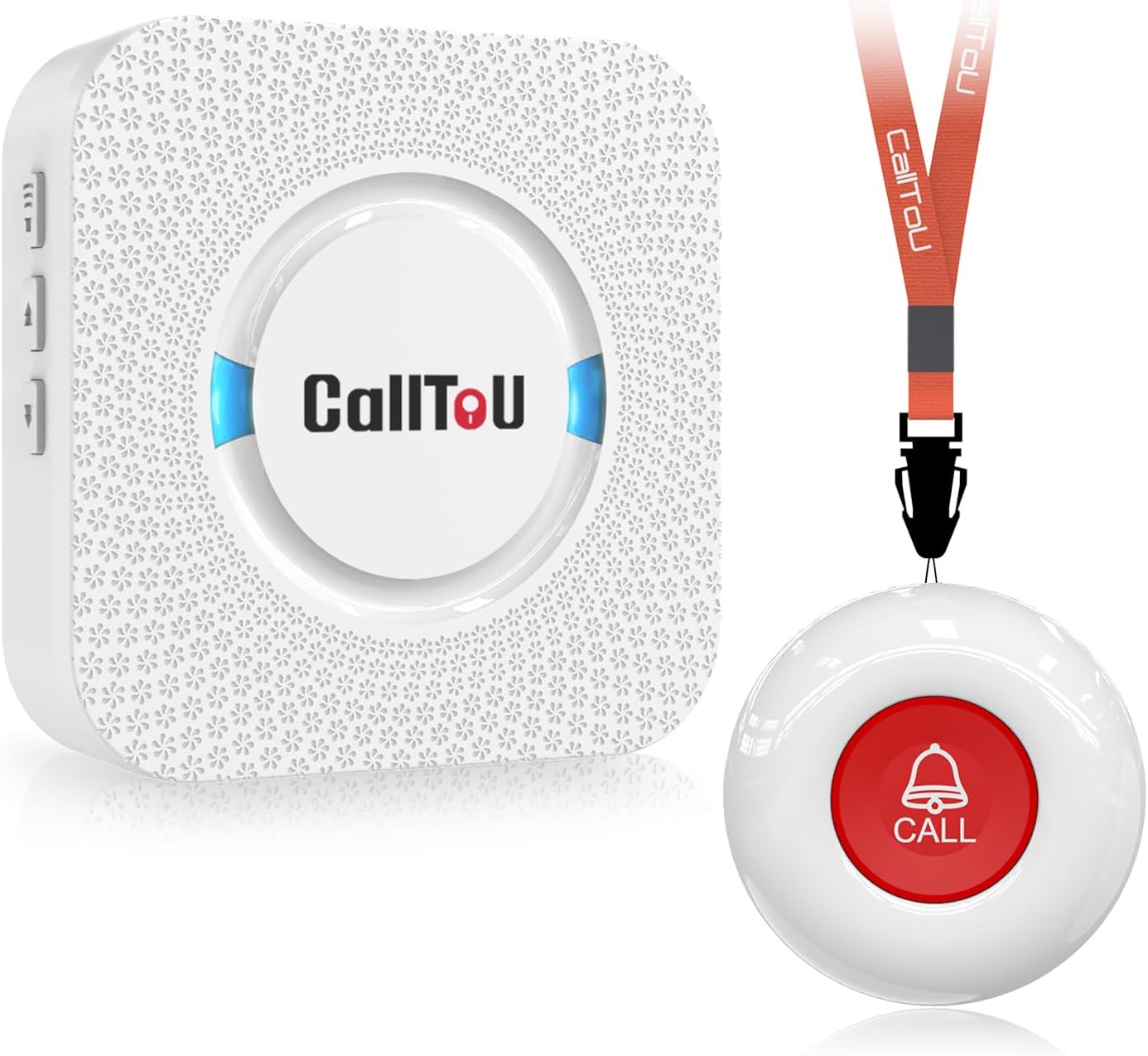
Outstanding coverage for the price. It comes with multiple magnetic door sensors and receivers, reaches far across a home, and — importantly for dementia — offers a wide volume range and dozens of chime tones, so you can keep the sound low and gentle to avoid startling a confused senior. You can assign different chimes to different doors and add more sensors as needed.
What we like
- Multiple sensors and receivers included
- Adjustable low volume avoids scaring seniors
- Long wireless range
- Tell doors apart by chime
Keep in mind
- Build is less premium
- Many settings to learn at first
- Place sensors out of reach
- Included
- Multiple sensors + receivers
- Range
- Up to ~1000 ft (open space)
- Tones
- Many chimes, 0-110 dB volume
- Per-door
- Different chime per door
- Expandable
- Add more sensors
Fosmon WaveLink Wireless Door Chime System

A gentle whole-home approach. Magnetic door sensors trigger plug-in receivers that play a pleasant chime rather than a siren, and you can place receivers in several rooms so you hear the alert wherever you are in the house. It's expandable to multiple doors and windows and avoids the distress a harsh alarm can cause.
What we like
- Soft chime instead of a siren
- Hear it anywhere with multiple receivers
- Expandable to many doors/windows
- Simple to set up
Keep in mind
- Receivers need power outlets
- No pager to carry outdoors
- Not a remote/phone alert
- Alert
- Pleasant chime (plug-in receivers)
- Coverage
- Multiple rooms (extra receivers)
- Sensors
- Magnetic, expandable
- Tones
- Selectable chimes/volume
- Install
- Adhesive sensors, plug-in receivers
Daytech Smart WiFi Caregiver Pager Door Alarm

The pick when you need to know a door opened while you are out — at the shops, at work, or asleep at the other end of a large house. Sensors talk to the plug-in receiver over their own radio link, and the receiver connects to your 2.4 GHz Wi-Fi and pushes a notification through the Tuya or Smart Life app.
That two-path design is the reason to choose this over a security-brand contact sensor. The receiver still chimes if your broadband drops, because the sensor never depended on the internet to reach it — the app is an extra layer, not the only one. A safety device that goes silent during an outage is not a safety device. You can also share access in the app, so a second family member gets the same alert without a second system, and it expands with more sensors as you cover more doors.
What we like
- Alerts reach you away from home, unlike a pager
- Local chime is independent of your broadband
- Shared access means a second carer sees the same alert
- Volume floor of 0 dB — silent with flashing LED only
Keep in mind
- 2.4 GHz Wi-Fi only — will not join a 5 GHz network
- App setup is a step beyond plug-and-pair; someone in the family needs to be comfortable with it
- Kit contents and range vary between Daytech listings — check the sensor count before ordering
- Phone alerts depend on your home connection staying up
Key features
- App alerts wherever you are, plus a local chime
- Receiver keeps working if the internet drops
- Share alerts with other family members
- Volume down to silent, or LED-only
- Expandable with more door and window sensors
- Alert
- Phone app + plug-in receiver
- App
- Tuya / Smart Life
- Wi-Fi
- 2.4 GHz only
- Volume
- 0—110 dB, 5 levels
- Sharing
- Multiple family members
What to look for
Alert the caregiver gently — not the patient
The point of a dementia door alarm is to reach you, not to startle your loved one. A loud siren at the door can frighten and agitate a confused person.
Choose a wireless caregiver pager, a soft chime, or a phone alert that tells you a door opened, and keep the volume low. The better systems let you adjust the tone and loudness precisely so the alert is calm rather than jarring.
Coverage and expandability
Map the exits that actually pose a risk before you buy.
Count the doors that matter — front, back, garage — plus any windows the person could reach. Then choose a system that pairs several sensors to one pager or receiver so you're not juggling devices, and consider one that also covers bed and chair exits on the same monitor for a single setup.
Sensor type and your doors
Most systems use a simple magnetic contact sensor — one piece on the door, one on the frame — that triggers when they separate, and these stick on with adhesive.
Sliding glass doors need a sensor positioned to bridge the slide, and a motion sensor can cover the approach to an exit rather than the door itself. Check that the sensor suits the specific doors you're monitoring.
Placement and tamper-resistance
Someone with dementia may try to remove a device that chimes, so where you mount it matters.
Place the sensor higher on the door or frame, out of the person's usual sightline and reach, and secure it firmly. Check it regularly to make sure it hasn't been moved or pulled off, and that the magnet still lines up.
Range, power, and installation
A few practical details decide how well it fits your home.
Match the wireless range to the size of your house and test it from where you'll actually be. Favor adhesive, no-wiring install, check battery life and low-battery indicators, and confirm whether it needs Wi-Fi — most pager systems don't, while smart phone-alert sensors do.
Tips to Choose Door Alarms
Short on time? Here are the key points to weigh before choosing, each covered in detail above:
- Alert the caregiver gently — not the patient
- Coverage and expandability
- Sensor type and your doors
- Placement and tamper-resistance
- Range, power, and installation
Comparing options? See our guides to Best Elderly Monitoring Systems, Best Medical Alert Devices for Seniors, and Best Ai Ambient Fall Detection Sensors.
Free things to try before you buy anything
Most of the Alzheimer’s Association’s wandering measures are changes to the door and the room rather than devices, and they work on the impulse to leave rather than on the moment after. Try these first — an alarm works better alongside them than instead of them.
- **Camouflage the door.** Paint it the same colour as the surrounding wall, or cover it with a removable curtain or screen. A door that does not read as a door is not an exit to head for.
- **Lay a black threshold.** A two-foot band of black tape or paint on the floor in front of the door often reads as a hole or a drop, and can act as a visual stop barrier.
- **Cover the door knobs** with cloth in the same colour as the door, or fit safety covers.
- **Add night lights** through the hallways, bedroom and bathroom. A good deal of night-time wandering starts as a disoriented trip to the toilet.
- **Hang warning bells** above the door. It is the low-tech version of everything on this page, it costs almost nothing, and it never needs a battery.
None of these confine anyone, which is exactly why they come first. They cut the number of times the door is tried at all, and the alarm covers the times they do not.
Signs the risk is rising
Wandering can begin at any stage, and it is far easier to prepare before the first incident than after one. The Alzheimer’s Association lists these as common signs that someone is at risk:
- Coming back from a regular walk or drive later than usual
- Forgetting how to get to familiar places
- Talking about fulfilling former obligations, such as going to work
- Trying or wanting to “go home” even when they are at home
- Becoming restless, pacing, or making repetitive movements
- Becoming anxious or disoriented in crowded places
If several of these are showing up, that is the moment to cover the doors and put a plan in place — not after someone has already been out on a cold night.
A door alarm is one layer — build the full plan
A door alarm buys you the moment to redirect, but preventing wandering safely takes more than one device, and no alarm guarantees a person won't get out.
The Alzheimer’s Association recommends fitting a deadbolt or latch above or below eye level on exterior doors, since a lock outside the usual line of sight is less likely to be noticed. Two parts of that advice are easy to miss and matter as much as the lock itself: **remove the locks on interior doors**, so the person cannot shut themselves inside a room you cannot open, and **keep a spare set of keys hidden near the door** so nobody is hunting for them in an emergency.
The firm rule underneath all of it: never lock a person in at home, and do not leave someone with dementia unsupervised in new or changed surroundings. A door the person cannot operate is a door they cannot escape through in a fire. A lock is only ever a delay that buys you time to respond — never a substitute for someone being there.
Beyond the door: a GPS tracker or ID in case they do leave, enrollment in a wandering-response programme, and meaningful daytime activity to ease the restlessness that drives much of this. Our dementia wandering guide covers the full approach.
Using door alarms day and night
Wandering often peaks in the late afternoon and overnight, so timing and pairing matter:
- Keep door alarms armed at night, and pair them with a bed alarm for the earliest possible warning.
- During the day, a soft chime keeps you aware without constant checking.
- Use vibrate or low volume on a pager so alerts reach you without startling the household.
- Treat these tools as an adjunct to supervision — test them regularly, since they support good caregiving rather than replace it.
See our dementia home safety guide for more.
Frequently asked questions
It's a sensor that alerts a caregiver when a monitored door opens, used to catch a person with dementia before they wander out. Most use a magnetic contact sensor — one piece on the door, one on the frame — that triggers an alert when the door opens. The alert can be a soft chime, a wireless pager the caregiver carries, or a notification to a phone, depending on the system.
They don't physically stop the person; they give the caregiver a timely warning so they can intervene and gently redirect before an exit becomes an elopement. Since about six in ten people with dementia wander, that early heads-up is valuable. Door alarms work best alongside secure locks, a GPS or ID, and supervision — they're one layer of a wider plan, not a standalone solution.
Most don't. The common pager and chime systems connect the door sensor directly to a receiver or pager over their own wireless signal, with no Wi-Fi, app, or monthly fee — which makes them simple and reliable. Only smart, phone-alert sensors need Wi-Fi and an app. If you want plug-and-play simplicity, choose a standalone pager or chime system.
They can if you use a loud siren, which is exactly why gentler options are better. Choose a system with adjustable volume and a soft chime, or one that alerts a pager or phone rather than sounding at the door, and keep the volume low. The goal is to alert you, the caregiver — not to startle a confused person, which could increase agitation or even cause a fall.
Yes — nearly all home dementia door alarms are designed for DIY installation. Magnetic sensors stick on with adhesive, pagers and chime receivers just need batteries or a power outlet, and no wiring or tools are required. The main thing to get right is placement: mount the sensor where the person can't easily see or reach it, and test the system before relying on it.
Cover every exit that poses a risk — typically the front and back doors and the garage, plus any reachable windows. Many systems let you pair several sensors to one pager or receiver, so you can monitor multiple doors without multiple devices. Start with the doors the person is most likely to use, and expand as you learn their patterns.
In a private home, monitoring your own doors is generally fine, and door alarms are a widely recommended safety measure. The important legal and safety line is that you must never lock a person in so they can't get out in an emergency, as that's a fire hazard and can raise confinement concerns. In care facilities, alarms and any door-securing measures are governed by specific regulations and consent rules.
It's common, so design around it. Mount the sensor higher on the door and out of their usual sightline, choose a discreet sensor, and check regularly that it's still in place and aligned. A silent system that alerts only your pager or phone gives the person nothing audible to react to or hunt for, which often reduces tampering.
Yes, with the right placement. A magnetic sensor can work on a sliding door if you position the two pieces so they separate when the door slides open — usually along the leading edge and the jamb. Some sensors are better suited to this than others, so check the product details, and consider a motion sensor covering the approach as an alternative.
Yes — nighttime and the late afternoon are when wandering often peaks, so keeping door alarms armed overnight is important. Pair them with a bed alarm so you're warned as soon as the person gets up, well before they reach a door, and set your pager to vibrate or low volume so it alerts you without waking the whole household.
The final verdict
For most caregivers, the Smart Caregiver wireless door system is the best choice — quiet pager alerts that integrate with bed and chair sensors. Choose the CallToU for the best-value expandable coverage with gentle, adjustable chimes, the Fosmon for a soft whole-home chime, or the Daytech Wi-Fi system for alerts on your phone when you are away from the house. The guiding principle: alert yourself gently rather than blasting a siren at the person, cover the exits that matter, place sensors out of reach, and treat the alarm as one part of a wandering-prevention plan that also includes secure locks, a GPS or ID, and supervision — never locking someone in.
Our overall winner is the Smart Caregiver Wireless Door/Exit Alarm with Pager — our best overall for most seniors. You can check the current price on Amazon to see today’s deal.
Keep comparing
